Every virtual try-on demo you’ve ever seen uses the same kind of garment: fitted, single-layer, body-contour-revealing. A t-shirt. A slim dress. That’s not an accident. It’s the case the underlying technology was built and trained for.
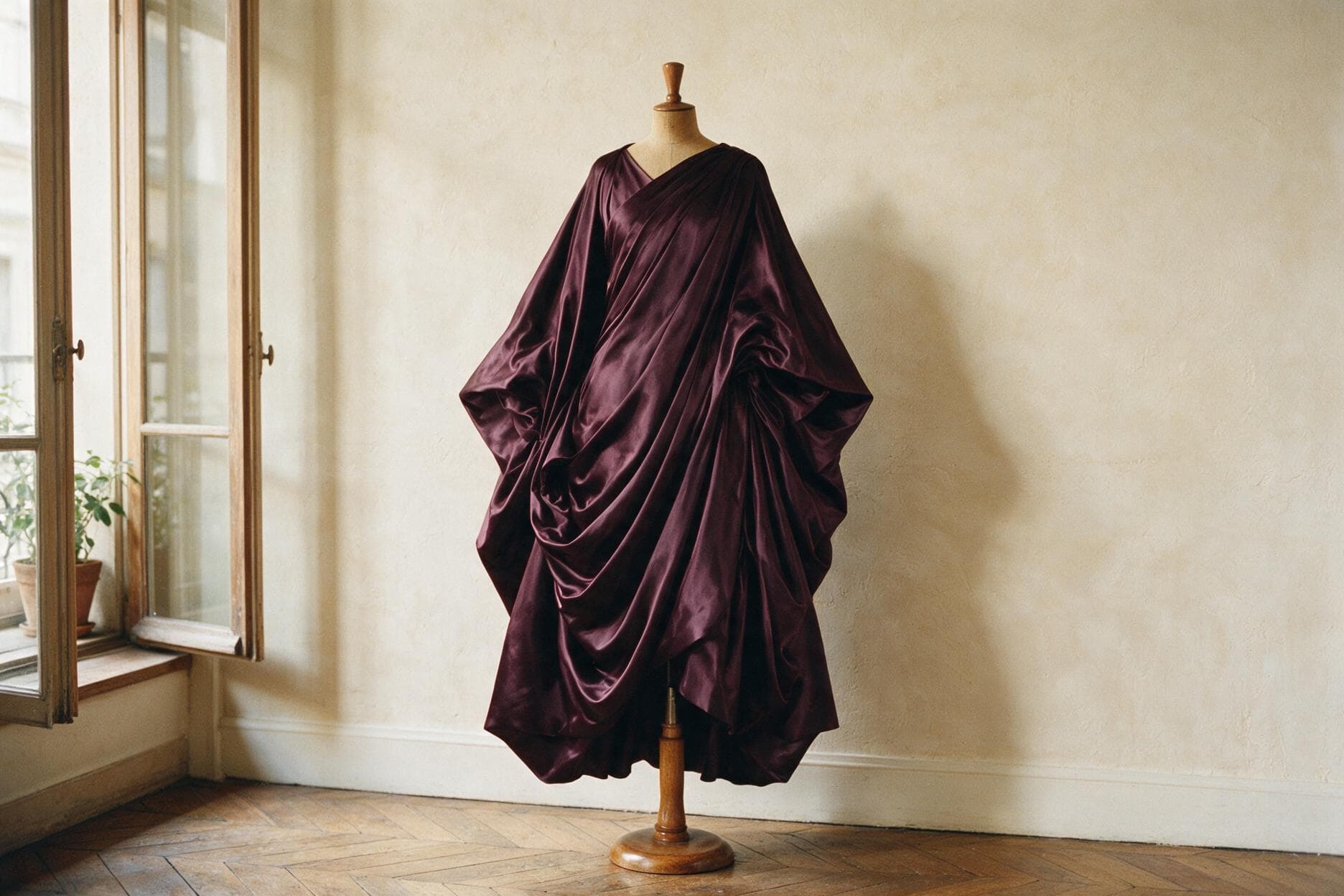
An abaya is close to the opposite case: loose, floor-length, opaque, worn as a single flowing layer over whatever’s underneath. A kaftan, a jalabiya, a formal outfit with a jacket over a dress — all variations on the same problem. We went looking for research on how well generative try-on actually handles this. Here’s what we found, and it’s more useful than another vendor demo.
Why does loose or draped clothing break virtual try-on?
Because the models rely on reading the body’s contour through the fabric to align a new garment, and loose clothing hides exactly that contour. Research from the University of Tokyo (Wu, Shen & Igarashi, 2025) states plainly that existing methods “rely on human body semantic maps to align garments with the body, but these maps become unreliable when body contours are obscured by loose-fitting garments, resulting in degraded outcomes.”
The paper also documents a training problem underneath the technical one: models are trained mostly on tight, contour-revealing garments, then asked at inference time to handle clothing they essentially never saw examples of. That’s a mismatch, not a bug you patch — it’s baked into how the systems learned in the first place.
There’s a second, more visible failure the same body of research documents: temporal jitter. Frame-by-frame rendering of loose fabric produces flickering, inconsistent motion, because flowing fabric legitimately looks different from one moment to the next even when the body underneath hasn’t moved — and the models don’t have a good way to tell the difference between real fabric motion and their own rendering noise.
Does Google’s own experience confirm this?
Yes, in Google’s own words. When Google extended its Shopping try-on from tops to dresses, it published why the extension took so long. Dresses, Google wrote, are “often more detailed than a simple top in their draping, silhouette, length or shape.” Its earlier approach to swapping garments would “smudge the person’s features or obscure important details of their body,” because a dress covers far more of the body than a top does — and switching to higher-resolution images alone didn’t solve it, since the standard approach still “often resulted in the loss of a dress’s critical details.”
Google’s own timeline tells the same story from a different angle. Tops and blouses in 2023. Dresses in September 2024 — over a year later. Shirts, pants, skirts and dresses in May 2025 — two years after the first launch. It took the best-resourced team in the field two years to get from a t-shirt to a skirt.
An abaya is a more extreme version of exactly the case that took Google two years to partially solve. It has not, as far as we found, attempted full-coverage, floor-length garments at all.
What about layered outfits — an abaya over a dress, a jacket over a shirt?
This is worse, and it’s architectural, not incremental. Research from the University of Washington (Feng, Chen, Shan & Kemelmacher-Shlizerman, 2026) explains that standard try-on methods build what’s called a “cloth-agnostic person representation” by masking out the garment already on the body — which, as the paper puts it, “irreversibly discards the essential contextual information — the very outfit upon which a new layer must be added.” The inner layer simply disappears in the output.
The same research notes that the standard training datasets used across this field consist “exclusively of single-item try-on examples” — meaning the models “have never observed the complex interplay of layered garments and thus cannot learn the required composition logic.” It’s not that layering is hard for these models. It’s that they were never shown an example of it.
An abaya worn over an outfit, a kaftan over a slip, a jacket over a dress for the cooler part of the evening — this is the default silhouette for a huge share of occasion wear in the Gulf, and it is precisely the case current architectures cannot do.
Is anyone doing this honestly?
One vendor we found does. TinTin, which sells AI-generated on-model imagery for abaya brands, states plainly on its own site: “Generic AI try-on tools were trained on Western silhouettes: they shorten hems, slim down loose cuts and open closed fronts.”
That’s the most useful sentence we found in this entire research pass, because it’s a competitor naming the actual failure mode instead of a marketing claim papering over it. Worth noting what TinTin actually built in response: not shopper-photo try-on, but generation from flat-lay images onto preset models, with explicit manual controls for sleeve style, front closure and fit — solving the problem by constraining the generation with garment-type parameters, rather than by inferring drape from a photo the way shopper-facing try-on has to.
That’s a legitimate, different approach to a different part of the problem — merchant-side product imagery, not customer-facing try-on. It doesn’t mean the shopper-photo problem is solved elsewhere. It means one vendor found a path around it for a narrower use case.
So what should a Gulf or modest-fashion brand actually expect today?
Treat any vendor’s abaya, kaftan or layered-outfit demo with real scepticism, and ask to test it on your own pieces before you commit to anything. The published research through 2026 says this is an open problem, not a solved one — for both loose single-layer garments and layered outfits.
Two things worth doing before evaluating any try-on tool for this category:
Test on your hardest garment, not your easiest. A vendor demo will show a fitted top or a simple straight dress because that’s the case the technology handles well. Ask specifically for a render of your most structured abaya, your most heavily layered look.
Ask what happens to fabric detail and opacity. None of the research we found addresses sheer versus opaque rendering directly — it’s simply understudied. Given that the documented failure mode is hallucinating detail in occluded regions, that’s a real open question for any garment where coverage and drape carry meaning, not just aesthetics.
Why we’re building toward this instead of avoiding it
We think the honest answer changes what the product should be for this segment. If the render is the weakest part of the technology on exactly the garments that matter most here, then the render should carry less of the weight — and the conversation that precedes it should carry more.
An occasion-first approach — the customer describes what she needs it for, gets a recommendation from the actual collection, and the try-on shows the result, not the whole argument — puts less pressure on the hardest technical case. It’s also, we think, the more honest way to sell into a category where the underlying research isn’t finished yet.
We’re not claiming to have solved the loose-garment or layering problem. Nobody has, publicly, as of this research. We’re building with that limitation in view rather than around it.
FAQ
- Does AI virtual try-on work reliably on abayas?
- Not yet, based on published research through 2026. Loose and draped garments break the body-contour estimation these systems rely on. Treat vendor demos with scepticism and ask to test on your actual pieces before committing.
- Why do loose clothes look worse in AI try-on than fitted clothes?
- Because the underlying models identify body shape by reading contours through fabric, and loose fabric hides those contours. Research from the University of Tokyo documents this directly: body semantic maps “become unreliable when body contours are obscured by loose-fitting garments.”
- Can AI try-on handle a jacket over a dress, or an abaya over an outfit?
- Not reliably. Layered garments require the model to preserve information about an existing outfit while adding a new layer — but the standard technique erases the existing garment first. Research from the University of Washington describes this as an architectural limitation, not a data problem that more training fixes on its own.
- Has any company solved this for modest fashion specifically?
- Not for shopper-facing try-on, as far as we found. One vendor, TinTin, addresses it for merchant-side product photography by generating garments onto preset models with manual style controls, rather than by inferring drape from a customer’s own photo.
Sources. Wu, Shen & Igarashi, University of Tokyo, “Real-Time Per-Garment Virtual Try-On with Temporal Consistency for Loose-Fitting Garments,” arXiv:2506.12348 (2025) · Feng, Chen, Shan & Kemelmacher-Shlizerman, University of Washington, “Layering Virtual Try-On,” arXiv:2607.22924 (2026) · Google Shopping blog, “Virtual try-on for dresses,” 5 September 2024 · TinTin, AI Abaya Models product page.
Last updated 25 August 2026.